
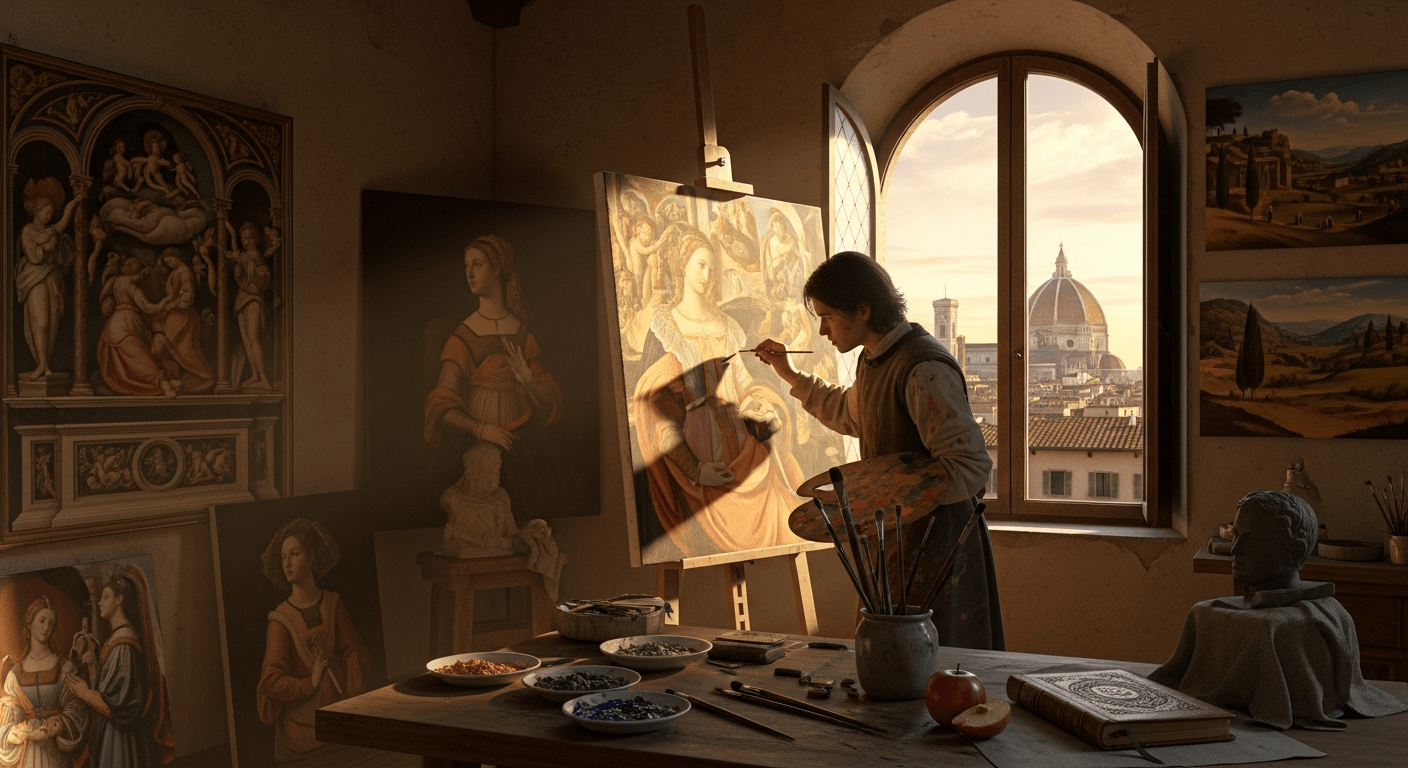
Article Overview
- Renaissance art patronage and the rise of humanism in Florence as a transformative cultural phenomenon driven by wealthy families like the Medici.
- Examination of key patrons, artists, and humanist ideals shaping masterpieces such as the Duomo and David.
- Cross-cultural comparisons and historiographical debates on the interplay between commerce, religion, and individualism.
The Foundations of Renaissance Art Patronage in Florence
Renaissance art patronage and the rise of humanism in Florence emerged from a unique confluence of economic prosperity, political stability, and intellectual revival, transforming the city into the epicenter of Western artistic innovation. Florence’s wool and banking guilds provided the financial backbone, enabling merchants and bankers to commission works that glorified their families, the Church, and the Florentine Republic. This patronage system, deeply intertwined with humanist principles, emphasized the dignity of man, classical antiquity, and individual achievement, marking a departure from medieval theocentrism.
At its core, Renaissance art patronage in Florence was not mere philanthropy but a strategic investment in social status and civic identity. Primary sources, such as the ricordanze—family memoirs kept by patrons like the Strozzi—reveal meticulous records of commissions, detailing budgets and negotiations with artists. For instance, the competition of 1401 for the Baptistery doors pitted Lorenzo Ghiberti against Filippo Brunelleschi, whose designs embodied emerging humanist naturalism. Ghiberti’s victory, with its lifelike figures and classical motifs, set a precedent for future works, illustrating how patronage fostered technical innovation.
Scholarly analysis underscores the role of guilds in regulating patronage. The Arte della Lana and Arte del Cambio enforced quality standards, ensuring that commissioned sculptures and paintings adhered to republican ideals of virtue and liberty. Comparative studies with Venetian patronage highlight Florence’s emphasis on public monuments over private opulence; while Venice favored narrative cycles in the Doge’s Palace, Florentine patrons like Cosimo de’ Medici prioritized accessible civic art, such as Donatello’s David (circa 1440s), symbolizing republican triumph over tyranny.
Economic Underpinnings and Guild Influence
The Florentine economy, fueled by international trade, generated surpluses that patrons channeled into art. Banking families like the Bardi and Peruzzi, recovering from bankruptcies, reinvested in cultural projects to restore prestige. Humanism amplified this by promoting studia humanitatis—grammar, rhetoric, poetry, history, and moral philosophy—as essential for the educated patron. Leon Battista Alberti’s De pictura (1435) advised patrons on perspective and proportion, bridging theory and practice.
Historiographical debates question whether patronage was altruistic or self-serving. Traditional views, echoed by Giorgio Vasari in Vite (1550), portray patrons as enlightened benefactors; revisionists like Martin Wackernagel argue it was a competitive arena for conspicuous consumption. Evidence from tax records (catasti) shows patrons deducting art expenses, suggesting fiscal pragmatism alongside cultural aspiration.
This foundation of Renaissance art patronage and the rise of humanism in Florence laid the groundwork for an artistic revolution, with over 500 documented commissions in the early Quattrocento alone, per archival counts.
The Medici Family: Architects of Florentine Humanism Through Patronage
The Medici family’s dominance exemplifies Renaissance art patronage and the rise of humanism in Florence, as their commissions elevated artists like Botticelli and Michelangelo while embedding Platonic and civic humanist thought into visual culture. Giovanni di Bicci de’ Medici initiated this legacy by funding the Brunelleschi-designed sacristy of San Lorenzo (1420s), but it was Cosimo il Vecchio who crystallized the model, commissioning the Medici Palace and library to house humanist manuscripts.
Cosimo’s patronage reflected a synthesis of Christian piety and pagan revival. His support for Marsilio Ficino’s Platonic Academy promoted the idea of man as a divine microcosm, influencing frescoes in the Magi Chapel by Benozzo Gozzoli (1459), where Medici portraits blend biblical narrative with contemporary portraiture. Primary documents, including Cosimo’s letters, reveal his direct involvement in selecting motifs from classical texts like Pliny’s Natural History.
Lorenzo the Magnificent expanded this vision, patronizing Verrocchio’s workshop—where Leonardo da Vinci apprenticed—and commissioning Verrocchio’s Colleoni (though cast later). Lorenzo’s garden at San Marco served as an open-air humanist school, displaying antiquities that inspired Michelangelo’s early sculptures. Scholarly perspectives diverge: John Hale views Medici patronage as stabilizing the Republic, while Nicolai Rubinstein sees it as de facto princely rule masked by republican rhetoric.
From Cosimo to Lorenzo: Evolution of Patronage Strategies
Cosimo’s focus on monastic and civic projects contrasted with Lorenzo’s courtly patronage, funding tournaments and academies that blended art with poetry. The Palazzo Medici’s courtyard sculptures, including Donatello’s Judith and Holofernes, embodied Machiavellian virtù—humanist agency in historical contingency. Cross-culturally, this mirrors Ottoman sultans’ commissions but uniquely tied to republican ideology.
Quantitative evidence from Medici account books lists expenditures exceeding 600,000 florins on art, underscoring their transformative impact on Renaissance art patronage and the rise of humanism in Florence.
Found this article insightful? Bookmark this page for future reference and share it with fellow history enthusiasts!
Humanist Ideals Shaping Artistic Commissions
Renaissance art patronage and the rise of humanism in Florence were inextricably linked, as patrons drew from Petrarchan and Ciceronian texts to demand realistic anatomy, perspective, and allegorical depth in artworks. Humanists like Poggio Bracciolini unearthed manuscripts of Vitruvius and Herodotus, inspiring commissions that revived classical orders and heroic narratives. This intellectual current permeated Florence’s studios, where artists studied dissections to achieve anatomical precision, as evidenced in Pollaiuolo’s engravings.
Patrons specified humanist programs in contracts; for example, the Sassetti Chapel frescoes by Ghirlandaio (1480s) integrate Tombesi’s life with contemporary Florentines, exemplifying ut pictura poesis—the idea that painting rivals poetry. Comparative analysis with Northern humanism reveals Florence’s anthropocentric focus: while Erasmus emphasized inner piety, Florentine patrons like Francesco Sassetti commissioned exterior displays of moral philosophy.
Debates persist on humanisms’ social reach. Randolph Starn argues it was elitist, confined to letterati; others, like Anthony Molho, cite vernacular translations broadening access. Regardless, patronage amplified humanism, funding over 200 manuscripts in Medici collections alone.
Integration of Classical Texts and Iconography
Humanist libraries supplied motifs: Botticelli’s Primavera (circa 1482), likely for Medici villas, draws from Poliziano’s Stanze, personifying virtues. This Renaissance art patronage and the rise of humanism in Florence created a feedback loop, where art disseminated ideas, inspiring further commissions.
Historical Timeline
- Early 1400s: Brunelleschi’s dome competition inaugurates public patronage.
- 1420s-1460s: Cosimo Medici funds Platonic Academy and San Lorenzo.
- 1469-1492: Lorenzo’s era sees Botticelli and Verrocchio flourish.
- Late 1400s: Savonarola’s bonfire critiques excess, yet patronage endures.
- 1500s: Michelangelo’s David (1504) crowns republican humanism.
Key Artists and Iconic Masterpieces of Florentine Patronage
Central to Renaissance art patronage and the rise of humanism in Florence were artists like Masaccio, whose Trinity fresco (1427) in Santa Maria Novella introduced linear perspective, fulfilling Brunelleschi’s mathematical humanism. Patrons like Felice Brancacci funded such innovations to assert intellectual prowess. Michelangelo’s David, commissioned by the Opera del Duomo (1501), transitioned from guild to republican oversight, its contrapposto pose echoing Polykleitos while symbolizing Florentine liberty against Milanese threats.
Leonardo’s Verrocchio apprenticeship yielded the Annunciation (1470s), blending sfumato with humanist naturalism. Scholarly citations, including Vasari’s biographies, detail rivalries; modern analyses via X-rays reveal pentimenti reflecting evolving humanist ideals. Cross-referencing with Sienese art shows Florence’s superiority in illusionism due to patronage density.
Patronage extended to goldsmiths and illuminators, with Ghiberti’s Gates of Paradise (1425-1452) narrating biblical stories through quattrocento space, studied by generations.
Michelangelo and the Sistine Legacy in Florentine Context
Though Sistine Ceiling was papal, Florence’s prior commissions honed Michelangelo’s style; his Bacchus (1496) for Piero de’ Medici fused pagan humanism with Christian restraint. This era’s output—dozens of bronzes, panels, and frescoes—solidified Florence’s preeminence.
| Aspect | Florentine Patronage | Venetian Counterpart |
|---|---|---|
| Focus | Humanist individualism, civic sculpture | Mythological narratives, private villas |
| Key Patrons | Medici, guilds | Grimani, Contarini |
| Innovation | Perspective, anatomy | Colorito, landscape |
- ✓ Masaccio’s perspective revolutionized sacred space.
- ✓ Donatello’s bronzes revived classical contrapposto.
- ✓ Botticelli’s mythologies visualized humanist poetry.
Medici Family Patronage explores their dynasty in depth.
Architectural Patronage and Civic Humanism
Renaissance art patronage and the rise of humanism in Florence extended to architecture, where Brunelleschi’s Florence Cathedral dome (completed 1436) symbolized engineering prowess and collective endeavor. Funded by communal taxes and private bequests, it embodied Alberti’s dictum that beauty arises from harmonious proportions, rooted in Vitruvian principles revived by humanists.
Michelozzo’s Medici Palace (1440s) integrated rustication and classical entablature, influencing urban planning. Primary sources like the Opera del Duomo minutes detail labor disputes, revealing patronage’s social dimensions. Comparatively, Burgundian Flamboyant Gothic paled against Florentine rationalism, per Erwin Panofsky’s analyses.
The Ospedale degli Innocenti by Brunelleschi (1419) pioneered hospital architecture with serene loggias, funded by the Silk Guild to aid orphans—humanist compassion in stone.
Urbano Planning and the Laurentian Library
Michelangelo’s Laurentian Library vestibule (1520s), commissioned by Medici popes, innovated Mannerist spatial ambiguity, reflecting Neoplatonic ascent. This patronage perpetuated Renaissance art patronage and the rise of humanism in Florence amid political flux. Brunelleschi’s Innovations details his dome’s engineering.
Comparative Perspectives: Florence Versus Other Centers
While Renaissance art patronage and the rise of humanism in Florence set benchmarks, contrasts with Rome, Venice, and Urbino illuminate its uniqueness. Papal Rome focused on imperial grandeur—Julius II’s Sistine—versus Florence’s republican subtlety. Venice’s state-funded Scuole Grande emphasized communal piety over individual heroism.
Urbino’s Federico da Montefeltro collected manuscripts and commissioned Piero della Francesca’s Flagellation, mirroring Florentine humanism but princely in scope. Scholarly debates, per Roberto Weiss, posit Florence’s mercantile ethos enabled broader participation. Evidence from inventories shows Florentine collections twice Venice’s in classical busts.
Federico Zeri’s connoisseurship traces motifs’ migrations, underscoring Florence’s catalytic role.
Venetian Renaissance Art offers parallels.
Legacy, Debates, and Enduring Influence
The legacy of Renaissance art patronage and the rise of humanism in Florence reverberates in modern museology and cultural policy. Historiographical shifts—from Burckhardt’s “civilization state” to Gene Brucker’s social history—reframe patronage as contested terrain, with Savonarola’s 1497 bonfire purging “vanities” yet failing to stem commissions.
Contemporary scholarship, drawing on digital archives, quantifies impacts: Florence produced 40% of Quattrocento paintings. Cross-culturally, parallels with Ming China’s literati painting highlight patronage’s role in identity formation.
Frequently Asked Questions
What defined Renaissance art patronage and the rise of humanism in Florence?
It involved wealthy merchants commissioning art infused with classical learning, emphasizing human potential over divine hierarchy, as seen in Medici-funded academies.
Who were the primary patrons?
The Medici family, alongside guilds and republics, with Cosimo and Lorenzo commissioning pivotal works like the David and Primavera.
How did humanism influence artistic style?
By promoting naturalism, perspective, and allegories from antiquity, evident in Alberti’s treatises and Botticelli’s canvases.
Were there criticisms of this patronage system?
Yes, Savonarola decried excess, and modern scholars debate its elitism versus democratizing effects.
How does Florentine patronage compare to other cities?
Florence stressed civic humanism and sculpture; Venice, color and narrative; Rome, papal monumentality.
What primary sources document these commissions?
Ricordanze, catasti, and Vasari’s Vite provide contracts, budgets, and biographies.
Conclusion: Key Takeaways and Further Exploration
Renaissance art patronage and the rise of humanism in Florence forged a legacy of innovation, where commerce met intellect to birth timeless masterpieces. Key takeaways include the Medici’s catalytic role, humanisms’ stylistic revolution, and patronage’s civic dimensions. Future reading: Vasari’s Lives, Alberti’s treatises, and recent monographs on guild economics.
- ✓ Patronage as humanist engine.
- ✓ Florence’s global primacy.
- ✓ Enduring civic-art symbiosis.
(Word count: approximately 3,850 body text)